
2.2 Responsible business conduct towards employees
Relevance of the topic for SZKB and its objectives
As an employer, SZKB has the ability to shape the professional development of its employees in their work roles. This can have both negative and positive effects. Opportunities and risks relating to business conduct vis-à-vis employees can be divided into an inside-out perspective and an outside-in perspective:
- Inside-out – the impact of SZKB on employees and society: As a significant employer in the Canton of Schwyz, SZKB has a direct influence on the well-being, development and job satisfaction of its employees, thereby also having an impact on society. An open corporate culture strengthens identification with the Bank and promotes satisfaction, employee retention by the company and the positive perception of SZKB as a responsible employer (employer branding). At the same time, it is important to avoid negative effects such as harm to health, discrimination in the workplace or loss of employability. The aim is to create a working environment that supports health, equal opportunities and individual development.
- Outside-in – the impact of external factors on SZKB: Social changes, rising expectations in terms of employer responsibility and environmental challenges are increasingly influencing SZKB’s HR strategy. Topics such as sustainable mobility, flexible working models and responsible remuneration policies are gaining in importance. The reduction of commuting emissions, as well as the design of a transparent, balanced remuneration policy, helps to fulfil environmental and social requirements while ensuring competitiveness on the labour market.
With this approach, SZKB identifies areas in which action is required, minimises risks and strengthens its role as a responsible employer and sustainable institution.
SZKB has defined «Diversity and integration», «remuneration of the highest governance bodies» and «commercial traffic/commuter traffic»1 as key topics in the area of responsible business conduct towards employees and set the following targets (climate targets are presented in the Climate Report of Schwyzer Kantonalbank):
- SZKB fulfils its role as a training company by providing a number of apprenticeship and internship positions equivalent to a minimum of 5% of the workforce.
- SZKB acts as a socially responsible employer by providingjob opportunities for individuals with disabilities, such as through reintegration programs or through the continued employment of employees with limited capacity, with at least 1% of its employees taking advantage of such opportunities.
- The number of sickness-related absence days per employee (FTE) is less than 5.0 days per year.
- The (unexplained) pay gap between the genders is no more than 2.5%.
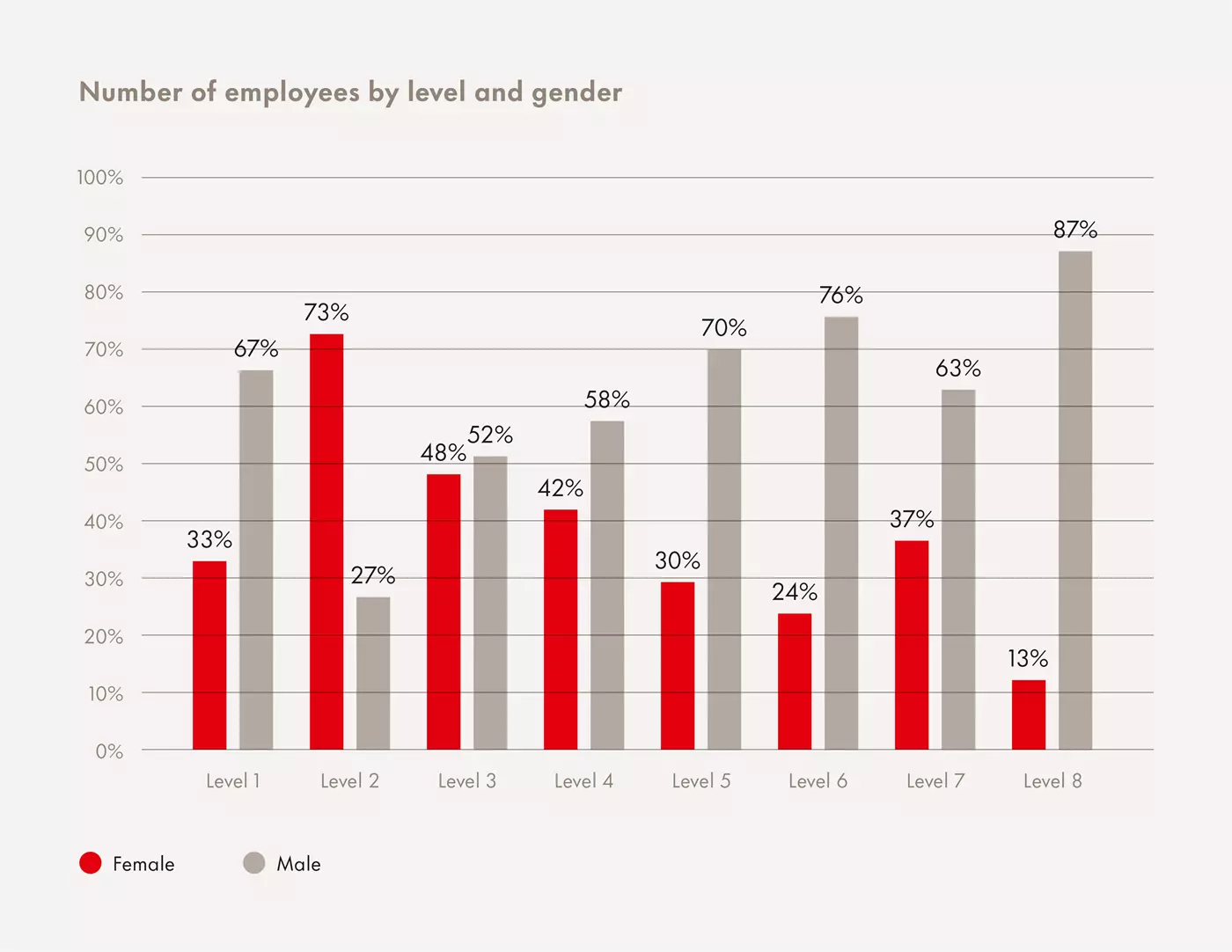
- By 2030, there will be a minimum of 25% representation of both genders among employees at all levels, including the Executive Board.
1The key topics of «commercial traffic/commuter traffic» and «climate change» and the related targets are covered in Chapter 5 Climate Report and are not addressed in this chapter.
Management approach
Organisation
The strategic responsibility for human resources policy lies with the Bank Council, its Personnel Committee (PEA) and the Executive Board. These bodies perform central tasks in managing and monitoring the Bank’s HR strategy and policy. The Human Resources department (HR) is responsible for the operational design and implementation of the human resources strategy. It reports directly to the CEO and is responsible for the development and implementation of the HR strategy. It covers the areas of digitalisation in HR, strategic HR projects (such as workforce planning), talent and leadership development, as well as an expanded range of apprenticeships, operational excellence (HR processes and workflows) and HR communication.
The Bank Council, in particular the Personnel Committee, is responsible for key decisions in the area of human resources policy. This includes the appointment and dismissal of members of the Executive Board and the Board of Inspectors, approval of the Remuneration and Personnel Regulations and the organisation and development of the compensation model for the Executive Board or the Bank Council. These decisions are subject to supervision by the Cantonal Supervisory Commission and also include a determination of the fixed and variable elements of overall remuneration.
The Human Resources department is operationally responsible for the development and promotion of diversity, equality and integration within the organisation. It monitors compliance with relevant standards and implements measures that strengthen and further develop an inclusive corporate culture.
Preventing discrimination
Sexual harassment, bullying and discrimination of any kind are not tolerated at SZKB. Appropriate provisions have been incorporated into the «Personal Regulations» for this purpose. The appropriate channels for lodging complaints are managers, the Human Resources department or the members of the Executive Board. In addition, the whistleblowing process can be used. Irrespective of this, employees can contact the board of the Bank’s internal staff association for support and advice.
Remuneration model
The structure of the SZKB remuneration model is based on clearly defined levels (1–8 for employees, 9–10 for the Executive Board) and includes the following rules:
- Fixed remuneration: Employees on levels 1 and 2 receive a fixed basic remuneration.
- Variable remuneration: On level 3 and above, variable remuneration is possible in addition to fixed remuneration, although there is no legal entitlement to it (even if it has previously been paid).
- Variability criteria: The amount of variable remuneration depends on the level, individual performance (results and behaviour) and the total amount available. This is determined on the basis of the Bank’s adjusted business performance and is approved by the Bank Council.
The model reflects fair and performance-based remuneration and is adapted to and based on SZKB’s business performance.
People Days
Since 2022, «People Days» have been held each year, during which managers collectively calibrate the performance of their employees and assess their potential. This results in a uniform and fair understanding of evaluation systems as the basis for pay progression. Human Resources analyses the results to identify any potential distortions (e.g. due to gender, age or level).
Occupational safety and health
SZKB fosters a health-oriented corporate culture and minimises the risk of occupational illnesses. Its occupational health management is based on the pillars of prevention, intervention and integration. In the event of prolonged health-related absences, SZKB supports employees with professional advice in order to ensure a smooth reintegration or a transition to disability insurance (IV). In addition, external, independent care management provides support in the event of long-term illness or occupational overload.
Key measures
- Expanding attractive employment conditions
- Ensuring equal opportunities and equal pay
- Holding exercise weeks
- Establishing employee satisfaction
- Education and training at SZKB
| Number of employees, employment relationship and employment level (GRI 2-7) | 2025 | 2024 | Change¹ | 2023 | 2022 | 2021² |
| Total number of employees | ||||||
| Number of staff units (full-time equivalents)³ | 574 | 561 | 2.3% | 548 | 525 | |
| Number of employees (persons)⁴ | 666 | 647 | 2.9% | 638 | 610 | |
| of which in the Executive Board | 5 | 5 | 0.0% | 5 | 5 | |
| of which per level:⁵ | ||||||
| Level 1–2 | 151 | 145 | 4.1% | 159 | 162 | |
| Level 3–4 | 216 | 209 | 3.3% | 200 | 179 | |
| Level 5–6 | 248 | 239 | 3.8% | 231 | 220 | |
| Level 7+ | 51 | 54 | –5.6% | 48 | 49 | |
| of which number of apprentices | 34 | 29 | 17.2% | 30 | 29 | |
| of which number of interns | 7 | 5 | 40.0% | 5 | 5 | |
| Employees paid by the hour⁶ | 41 | 36 | 13.9% | 37 | 35 | |
| Employees by employment relationship (permanent/fixed-term/paid by the hour)⁷ | ||||||
| Persons in permanent employment⁸ | 651 | 637 | 2.2% | 628 | 603 | |
| of which women | 266 | 271 | –1.8% | 269 | 268 | |
| of which men | 385 | 366 | 5.2% | 359 | 335 | |
| Persons in fixed-term employment⁹ | 15 | 10 | 50.0% | 10 | 7 | |
| of which women | 9 | 6 | 50.0% | 4 | 2 | |
| of which men | 6 | 4 | 50.0% | 6 | 5 | |
| Persons employed on an hourly basis¹⁰ | 41 | 36 | 13.9% | 37 | 35 | |
| of which women | 41 | 35 | 17.1% | 36 | 34 | |
| of which men | 0 | 1 | –100.0% | 1 | 1 | |
| Employees by employment level (full-time/part-time)¹¹ | ||||||
| Full-time employees | 432 | 396 | 9.1% | 381 | 399 | |
| Women in full-time employment (compared to headcount) | 18.2% | 18.1% | 0.6% | 16.6% | 19.3% | |
| Women in full-time employment (compared to all women) | 44.0% | 42.2% | 4.3% | 38.8% | 43.7% | |
| Men in full-time employment (compared to headcount) | 46.7% | 43.1% | 8.4% | 43.1% | 46.1% | |
| Men in full-time employment (compared to all men) | 79.5% | 75.4% | 5.4% | 75.3% | 82.6% | |
| Part-time employees¹² | 234 | 251 | –6.8% | 257 | 211 | |
| Women in part-time employment (compared to headcount) | 23.1% | 24.7% | –6.5% | 26.2% | 24.9% | |
| Women in part-time employment (compared to all women) | 56.0% | 57.8% | –3.1% | 61.2% | 56.3% | |
| Men in part-time employment (compared to headcount) | 12.0% | 14.1% | –14.9% | 14.1% | 9.7% | |
| Men in part-time employment (compared to all men) | 20.5% | 24.6% | –16.7% | 24.7% | 17.4% | |
| New hires and turnover (GRI 401-1) | ||||||
| New hires¹³ | ||||||
| Number of employees (persons) | 82 | 71 | 15.5% | 83 | 67 | |
| of which employees under 30 years | 26 | 25 | 4.0% | 33 | 29 | |
| of which employees under 30 years (in percent) | 31.7% | 35.2% | –9.9% | 39.8% | 43.3% | |
| of which employees between 30 and 50 years | 41 | 32 | 28.1% | 40 | 32 | |
| of which employees between 30 and 50 years (in percent) | 50.0% | 45.1% | 10.9% | 48.2% | 47.8% | |
| of which employees over 50 years | 15 | 14 | 7.1% | 10 | 6 | |
| of which employees over 50 years (in percent) | 18.3% | 19.7% | –7.1% | 12.0% | 9.0% | |
| of which women | 29 | 26 | 11.5% | 31 | 31 | |
| of which women (in percent) | 35.4% | 36.6% | –3.3% | 37.3% | 46.3% | |
| of which men | 53 | 45 | 17.8% | 52 | 36 | |
| of which men (in percent) | 64.6% | 63.4% | 1.9% | 62.7% | 53.7% | |
| Employee Departures¹⁴ | ||||||
| Annual turnover (net) | 51 | 47 | 8.5% | 40 | 59 | |
| of which employees under 30 years | 13 | 15 | –13.3% | 16 | 10 | |
| of which employees under 30 years (in percent) | 25.5% | 31.9% | –20.1% | 40.0% | 16.9% | |
| of which employees between 30 and 50 years | 26 | 25 | 4.0% | 19 | 36 | |
| of which employees between 30 and 50 years (in percent) | 51.0% | 53.2% | –4.1% | 47.5% | 61.0% | |
| of which employees over 50 years | 12 | 7 | 71.4% | 5 | 13 | |
| of which employees over 50 years (in percent) | 23.4% | 14.9% | 57.0% | 12.5% | 22.0% | |
| of which women | 27 | 20 | 35.0% | 25 | 28 | |
| of which women (in percent) | 52.9% | 42.6% | 24.2% | 62.5% | 47.5% | |
| of which men | 24 | 27 | –11.1% | 15 | 31 | |
| of which men (in percent) | 47.1% | 57.4% | –17.9% | 37.5% | 52.5% | |
| Turnover (in percent) | ||||||
| Annual turnover rate (net)¹⁵ | 10.1% | 9.2% | 9.8% | 8.0% | 10.3% | |
| Annual turnover rate (gross)¹⁶ | 14.4% | 15.5% | –7.1% | 11.4% | 14.5% | |
| Diversity | ||||||
| Governance bodies (GRI 405-1)¹⁷ | ||||||
| Number of Bank Council members: | 9 | 9 | 0.0% | 9 | 9 | |
| of which women | 1 | 1 | 0.0% | 1 | 1 | |
| of which women (in percent) | 11.1% | 11.1% | 0.0% | 11.1% | 11.1% | |
| of which men | 8 | 8 | 0.0% | 8 | 8 | |
| of which men (in percent) | 88.9% | 88.9% | 0.0% | 88.9% | 88.9% | |
| Age structure Bank Council: | ||||||
| Proportion of Bank Council members under 30 years | 0.0% | 0.0% | 0.0% | 0.0% | 0.0% | |
| Proportion of Bank Council members 30–50 years | 22.2% | 44.4% | –50.0% | 44.4% | 44.4% | |
| Proportion of Bank Council members over 50 years | 77.8% | 55.6% | 39.9% | 55.6% | 55.6% | |
| Number of Executive Board members: | 5 | 5 | 0.0% | 5 | 5 | |
| of which women | 1 | 2 | –50.0% | 1 | 1 | |
| of which women (in percent) | 20.0% | 40.0% | –50.0% | 20.0% | 20.0% | |
| of which men | 4 | 3 | 33.3% | 4 | 4 | |
| of which men (in percent) | 80.0% | 60.0% | 33.3% | 80.0% | 80.0% | |
| Age structure Executive Board: | ||||||
| Proportion of Executive Board members under 30 years | 0.0% | 0.0% | 0.0% | 0.0% | 0.0% | |
| Proportion of Executive Board members 30–50 years | 20% | 60% | –66.7% | 80.0% | 100.0% | |
| Proportion of Executive Board members over 50 years | 80% | 40% | 100.0% | 20.0% | 0.0% | |
| Age structure (GRI 2-7)¹⁸ | ||||||
| Employees under 30 years | 24.1% | 23.4% | 3.0% | 23.4% | 23.6% | |
| Employees between 30 and 50 years | 47.2% | 47.6% | –0.8% | 47.0% | 46.4% | |
| Employees over 50 years | 28.7% | 29.0% | –1.0% | 29.6% | 30.0% | |
| Levels (own standard)¹⁸¹⁹ | ||||||
| Proportion of women level 1 | 33.3% | 35.5% | –6.2% | |||
| Proportion of men level 1 | 66.7% | 64.5% | 3.4% | |||
| Proportion of women level 2 | 73.0% | 66.4% | 9.9% | |||
| Proportion of men level 2 | 27.0% | 33.6% | –19.6% | |||
| Proportion of women level 3 | 48.4% | 54.3% | –10.9% | |||
| Proportion of men level 3 | 51.6% | 45.7% | 12.9% | |||
| Proportion of women level 4 | 42.2% | 42.7% | –1.2% | |||
| Proportion of men level 4 | 57.8% | 57.3% | 0.9% | |||
| Proportion of women level 5 | 29.6% | 32.9% | –10.0% | |||
| Proportion of men level 5 | 70.4% | 67.1% | 4.9% | |||
| Proportion of women level 6 | 24.1% | 24.6% | –2.0% | |||
| Proportion of men level 6 | 75.9% | 75.4% | 0.7% | |||
| Proportion of women level 7 | 36.8% | 33.3% | 10.5% | |||
| Proportion of men level 7 | 63.2% | 66.7% | –5.2% | |||
| Proportion of women level 8 | 12.5% | 14.3% | –12.6% | |||
| Proportion of men level 8 | 87.5% | 85.7% | 2.1% |
1 All changes are shown as percentages (relative change).
2 No key figures are shown for 2021, as SZKB implemented a new HR system in 2022.
3 Excluding employees paid on an hourly basis and banking authority employees, including apprentices and interns (included at 50% as per SNB requirements).
4 Excluding employees paid on an hourly basis and banking authority employees, including apprentices and interns.
5 Explanations on the levels in chapter 2.2.1 Relevance, objectives, management approach and measures.
6 Hourly employees are not included in the other figures.
7 Excluding banking authority employees.
8 Apprentices and interns are counted as permanent employees. Excluding hourly employees.
9 Excluding hourly employees.
10 Hourly employees are not included in the other figures.
11 Excluding hourly employees and banking authority employees, including apprentices and interns.
12 Since 2025, apprentices have been counted as full-time employees (previously part-time employees).
13 New employees with a fixed-term employment relationship are not included.
14 Departures of employees with a fixed-term employment relationship and retired persons are not included.
15 Number of departures of permanent employees (as a percentage of the total headcount at the end of the year)
16 Number of departures (including retirements, deaths and terminations by the employer) (as a percentage of the total headcount at the end of the year).
17 The governance bodies comprise the Bank Council and the Executive Board.
18 Including the Executive Board, excluding Bank Council members.
19 Due to a change in the computational logic, figures are only available from 2024.
Expanding attractive employment conditions
Switzerland offers a solid social network and fair employment law standards, which are also applied at SZKB.
- Pension fund: The entire annual salary, including the variable component and excluding the coordination deduction, is insured with the Pension Fund of the Canton of Schwyz. SZKB also enables employees to create additional retirement capital separately from their management pension plan, if desired as a retirement pension. Through voluntary supplementary savings contributions, retirement provision can be extended and additional protection obtained to cover death and disability.
- Maternity: Employees receive 100% of their salary (fixed and variable remuneration) for a period of four months without any reduction in holiday entitlement.
- Child and family allowances: SZKB pays a voluntary family allowance for each child in addition to child allowances for employees with children up to the age of 20.
- Reconciling work commitments and family life: Employees with at least a 50% workload (mothers or single fathers) receive financial support for external childcare as well as free advisory and brokerage services. These regulations also apply to part-time employees, adjusted on an FTE basis.
- Compatibility of work commitments and private needs: SZKB offers its employees a highly flexible working schedule. Working hours can be freely performed within an extended time window from Mondays to Saturdays between 6.00 a.m. and 11.00 p.m. This rule enables an optimal balance between work commitments and private needs and fosters a modern, performance-focused and employee- friendly work culture. Employees in the 58+ age group have had the option of partial retirement since 2025. They can reduce their workload by 20% without any financial losses under the pension scheme. These will be compensated by the Bank.
| Parenthood (GRI 401-3) | 2025 | 2024 | Change¹ | 2023 | 2022 | 2021 |
| Returning to work after parental leave | ||||||
| Employees who took parental leave | 19 | 23 | –17.4% | 20 | 26 | |
| Women | 11 | 8 | 37.5% | 13 | 14 | |
| Men | 8 | 15 | –46.7% | 7 | 12 | |
| Employees who returned to work after parental leave | 95.0% | 92.0% | 3.3% | 95.2% | 92.9% | |
| Return rate for women | 91.7% | 80.0% | 14.6% | 92.9% | 93.3% | |
| Return rate for men | 100.0% | 100.0% | 0.0% | 100.0% | 92.3% | |
| Retention after returning to work | ||||||
| Employees still employed after 12 months | 90.0% | 90.5% | –0.6% | 87.5% | ||
| Retention rate for women | 66.7% | 85.7% | –22.2% | 93.8% | ||
| Retention rate for men | 100.0% | 100.0% | 0.0% | 81.3% | ||
| Number of employees retained | 18 | 19 | –5.3% | 28 | 22 | |
| Women | 6 | 12 | –50.0% | 15 | 14 | |
| Men | 11 | 7 | 57.1% | 13 | 8 |
1 No key figures are shown for 2021, as SZKB implemented a new HR system in 2022.
2 Returning to work refers to all employees who are taking or have taken parental leave during the reporting year.
3 The figure shows the ratio of employees who took parental leave to those who continued working after the end of parental leave.
4 Retention is measured one year after returning to work (after parental leave). It is not yet possible to report the figures up to and including 2022.
Ensuring equal opportunities and equal pay
SZKB promotes equal opportunities and family-friendly policies with a focus on reconciling work commitments and private life. Flexible working models, the option of working from home and childcare allowances support employees, regardless of their childcare arrangements. With a rate of employment of 50% or above, employees who are mothers or single parents benefit from financial support. Part-time models are available to all genders. The internal women’s network offers regular events and further training for professional and personal development. In addition, SZKB conducts a pay equality analysis every two years to ensure that any adjusted salary gap is lower than 2.5%.
Holding exercise weeks
In spring 2025, SZKB held «exercise weeks» as part of its corporate health management plan. Employees at various locations were able to take advantage of free sports, lectures and workshops on topics such as health, nutrition and resilience. In addition, SZKB offers anonymous stress tests as an early warning system in conjunction with an external partner and provides individual coaching if needed.
Establishing employee satisfaction
Every two years, SZKB conducts an employee satisfaction survey in cooperation with an external partner. The results of the survey are used to gain insights into employee needs, identify potential for improvement and derive targeted measures, such as with regard to working conditions or the corporate culture. SZKB also uses pulse checks (surveys carried out during the year) of the workforce as needed in order to review the effectiveness of the initiated measures.
The results are fed directly into strategic human resources development and support the Bank in maintaining and developing its attractiveness as a responsible employer.
| Equal pay analysis | 2025 | 2023 | ||||
| Adjusted salary gap | ≥2.5% | ≤2.5% | ||||
| Employee satisfaction | 2025 | 2023 | Change | 2021 | ||
| Employee satisfaction at overall bank level (0 lowest value; 100 highest value) | 76 | 77 | –1.3% | 78 | ||
| Illness and accidents (GRI 403–9 and 403–10) | 2025 | 2024 | Change | 2023 | 2022 | 2021¹ |
| Days of absence per employee | 4.5 | 5.2 | –13.5% | 4.8 | 4.7 | |
| thereof sick days² | 4.1 | 4.5 | –8.9% | 4.2 | 4.5 | |
| thereof accident days | 0.4 | 0.7 | –42.9% | 0.6 | 0.3 | |
1No key figures are shown for 2021, as SZKB implemented a new HR system in 2022.
2Long-term absences are included.
Education and training at SZKB
SZKB attaches great importance to education and training for its employees in order to promote their employability and support lifelong learning.
- Core training and fostering of young talent: SZKB is actively involved in the education and promotion of young talent in order to create a solid basis for future specialists. Its commitment includes practical training programmes that prepare young talent in a targeted manner for the professional challenges ahead. SZKB offers various occupational profiles for core training. If necessary, new occupational profiles are created and introduced.
- Talent and leadership programmes: With an 18-month talent programme, the Bank supports potential beneficiaries in order to strengthen their leadership and cross-departmental expertise. Four women and seven men are taking part in the group, which started in 2024. Since 2021, a leadership programme has assisted in the further development of executives, which has continued in the form of «leadership circles» since 2023.
- Training opportunities: SZKB offers employees access to their own learning platform, an external learning library and support for part-time training.
- Advisory certifications: Client advisors are certified according to SAQ within 18 months in order to ensure high standards of advice. For employees who require an investment fund licence, this must be obtained within 6 to 12 months.
- ESG training: SZKB conducts ESG training courses. SAQ-certified training courses are offered in an e-learning format and are mandatory for all new entrants. Further training with a focus on ESG in advisory services is available for client advisors. In addition, SZKB has introduced certified external specialist courses for selected employees and managers, and refresher training for all employees is being prepared for the coming years.
| Training and education (GRI 404–1) | 2025 | 2024 | Change | 2023 | 2022 | 2021¹ |
| Total employees in training | 41 | 34 | 20.6% | 35 | 34 | |
| thereof apprentices | 34 | 29 | 17.2% | 30 | 29 | |
| thereof interns | 7 | 5 | 40.0% | 5 | 5 | |
| Employees engaging in external training and education alongside work (GRI 402–2) | 66 | 34 | 94.1% | 78 | 49 | |
| Number of degrees at the tertiary level | 15 | 22 | –31.8% | 33 | 31 | |
| Number of SAQ certifications | 19 | 2 | 850.0% | 0 | 7 | |
| Number of Banking Course completions | 6 | 11 | –45.5% | 12 | 9 | |
| Training costs (own standard) | ||||||
| Total external training costs in CHF million | 1.0 | 1.3 | –23.1% | 1.3 | 1.0 | |
| Total external training costs as a percentage of human resource expenses | 1.1% | 1.4% | –21.4% | 1.1% | 1.2% | |
| Total external training costs, CHF per employee | 1'452 | 2'028 | –28.4% | 1'611 | 1'591 |
1 No key figures are shown for 2021, as SZKB implemented a new HR system in 2022.
Information on the remuneration of the highest governance bodies is disclosed in the SZKB Annual Report.
Assessment of effectiveness
SZKB uses a wide range of measures to promote its employees and create a modern, supportive working environment. Programs for advanced training, flexible working time models and initiatives such as the SZKB women’s network help contribute to skill enhancement and increased workforce satisfaction. Regular surveys ensure that the measures are effectively implemented and adapted continuously to the needs of employees. At SZKB, HR topics and processes are well anchored in the Bank Council, the Executive Board, the HR department and line management. Overall, SZKB considers the measures taken to have been effective.
SZKB has a comprehensive set of tools to promote equal treatment, employee satisfaction and personal development. Enhanced employment conditions, family-friendly benefits and flexible working models make a significant contribution to ensuring that work is compatible with private life and enhance employer attractiveness. Transparency in assessment and remuneration is ensured through equal pay analyses as well as structured formats such as the «People Days».
Initiatives such as the exercise weeks and the range of anonymous stress tests actively promote health and well-being. The regular employee survey provides valuable information for the development of the corporate culture. In addition, targeted education and training, talent programmes and ESG training courses enhance the skills and future adaptability of employees.
Overall, the effectiveness of the measures is reflected by a high employee identification with SZKB as well as sustainable staff turnover. Moreover, the action taken is considered to be meaningful and effective.
Further development and next steps
Additional new apprenticeships will be introduced in 2026.