
5.5 Key figures and targets
Emissions were calculated based on the global standards of the Greenhouse Gas Protocol (GHG) and the Partnership for Carbon Accounting Financials (PCAF), which SZKB adhered to in 2024. Primarily four business fields or areas within SZKB have been identified to calculate greenhouse gas emissions and their reduction targets, with further subdivision into fund business and asset management (AM) in the investment sector.
SZKB owns investment properties. There has not yet been any systematic collection and reporting of associated CO₂ emissions.
Financed emissions and key figures in the area of financing
SZKB has calculated the greenhouse gas emissions on its financing portfolio (Mortgage and credit area) (Scope 3, Category 15) as of 30 June 2025 (previous period 30 June 2024). The calculated values are used as the basis for measuring the emission intensity objectives.
SZKB allocated its financing portfolio to the following PCAF classes (this subdivision differs from the SZKB definitions used internally):
- Mortgages (owner-occupied residential property andcondominiums
- Commercial properties (outstanding mortgage financingwith mortgage liens)
- Corporate financing (other loans)
Business/ area | Financing business | Financial assets | Fund business | Assets under management | Direct and indirect operational greenhouse gas emissions |
Description | • Mortgage portfolio • Commercial property • Corporate loans | Financial assets | Own funds | • Custody account assets for advisory mandates • Custody account assets for discretionary mandates | • Direct emissions (Scope 1) • Indirect emissions from purchased energy (Scope 2) • Upstream and downstream value (Scope 3) |
Measurement | Yes | Yes | Yes, funds with «Focused» preference (ethical funds) | Yes, AM mandates with a «Focused» preference | Yes |
Objective | Yes, without corporate loans | No | Yes | Yes | Yes |
Following its adherence to the PCAF, SZKB has reviewed the calculation methodology and implemented the following methodological changes:
- Blank örK financing from corporate financing excluded (PCAF does not have emission factors for cantons, districts or municipalities but currently only at the state level).
- Mortgage financing of agricultural real estate will now be allocated to commercial real estate (previously to corporate loans). Operating loans remain under corporate loans. This is in line with the approach to commercial financing.
- For holding companies, financing has been divided up among the operating companies wherever possible.
- By adhering to the PCAF, SZKB has access to its emission factors. According to the PCAF recommendation, figures for «advanced economies» are adopted at the sectoral level.
In cases where values were missing, external public data sources were used for the calculation and, if necessary, average figures and estimates were derived from known values. The PCAF Data Quality Score reflects the average quality of the data used.
The emissions intensity shown pertains to the Scope 1 and Scope 2 emissions from financing. The PCAF also provides companies with emission factors for Scope 3. These are reported separately.
Financing¹ | 30/06/2025 | 30/06/2024 | Change | 31.12.2022 (base year) | Change during reporting year compared to base year | |
Volume/share of portfolio (CHF million) | ||||||
Mortgages | 8'502.3 | 8'139.2 | 4.5% | 7'658.4 | 4.5% | |
Commercial property | 9'524.7 | 9'113.5 | 4.5% | 7'801.7 | 4.5% | |
Corporate financing | 481.4 | 463.6 | 3.8% | 899.9 | 3.8% | |
Absolute emissions Scope 1 and 2 (ktCO₂e) | ||||||
Mortgages | 24.8 | 24.8 | 0.0% | 24.8 | 0.1% | |
Commercial property | 45.6 | 46.1 | –1.1% | 44.8 | –1.0% | |
Corporate financing | 47.9 | 55.5 | –13.7% | 52.2 | –13.7% | |
Carbon footprint Scope 1 and 2 (tCO₂ per CHF million financed volume) | ||||||
Mortgages | 2.9 | 3.0 | –3.3% | 3.2 | –4.2% | |
Commercial property | 4.8 | 5.1 | –5.9% | 5.7 | –5.3% | |
Corporate financing | 99.5 | 119.7 | –16.9% | 58.1 | –16.9% | |
Emissions intensity Scope 1 and 2 | ||||||
Mortgages (kgCO₂ per m² financed area) | 24.2 | 24.3 | –0.4% | 24.2 | –0.1% | |
Commercial real estate (kgCO₂ per m² financed area) | 23.2 | 23.3 | –0.4% | 23.3 | –0.2% | |
Corporate financing (tCO₂ per million CHF sales) | 107.4 | 113.1 | –5.0% | 123.0 | –5.1% | |
PCAF data quality score (Scope 1 and 2)² | 4.0 | 4.0 | 4.0 | |||
Absolute emissions Scope 3 (ktCO₂e) | ||||||
Corporate financing³ | 101.5 | 114.0 | –11.0% | 95.3 | –10.9% | |
PCAF data quality score (Scope 3)² | 4.3 | 4.2 | ||||
1 Outstanding amounts are selected and aggregated based on the PCAF standard. The subdivision into the asset classes of mortgages (residential properties) and mortgages (commercial properties) differs from the definitions commonly used by SZKB.
2 Weighted score.
3 PCAF requires Scope 3 disclosure only for the categories of corporate financing and unlisted investee companies (not relevant for SZKB).
The financed emissions for the mortgages and commercial properties have been calculated using the emission factors in kgCO₂/m2 (PCAF score 4, in an analogous manner to the previous year) for 2020 provided by PCAF. Financed corporate financing emissions have been calculated using the PCAF emission factors for «advanced economies» at the sectoral level (figures for 2019 in EUR, currency and inflation adjusted according to PCAF’s requirements as of the reference date). If no turnover or accounting data was available for the companies, the emissions were computed using the PCAF factors for score 5.
Corporate financing
30/06/2025 | 30/06/2024 | |||||
Sector name¹ | Financing volume (CHF m), sectors | Financed emissions (tCO₂e Scope 1 and 2), sectors | Financed emissions (tCO₂e Scope 3), sectors | Financing volume (CHF m), sectors | Financed emissions (tCO₂e Scope 1 and 2), sectors | Financed emissions (tCO₂e Scope 3), sectors |
Agriculture, forestry and fishing | 51.1 | 1'370.4 | 1'898.1 | 32.5 | 1'007.4 | 1'272.0 |
Manufacturing/production of goods | 37.6 | 9'201.5 | 21'810.0 | 43.6 | 7'607.8 | 24'908.4 |
Energy supply | 8.7 | 9'597.7 | 1'163.7 | 16.4 | 15'884.2 | 1'926.0 |
Water supply; sewage, waste disposal and decontamination | 29.8 | 10'006.8 | 1'732.5 | 9.6 | 10'460.9 | 1'550.3 |
Building trade/construction | 23.6 | 1'692.8 | 19'873.8 | 28.3 | 1'869.5 | 21'949.2 |
Trade, maintenance and repair of motor vehicles | 108.4 | 7'268.9 | 39'614.5 | 122.8 | 8'463.8 | 46'126.9 |
Transport and warehousing | 7.6 | 5'436.2 | 3'026.6 | 9.0 | 6'598.7 | 3'673.8 |
Catering/accommodation and gastronomy | 2.5 | 128.5 | 700.5 | 3.5 | 227.0 | 1'237.4 |
Information and communication | 2.6 | 68.0 | 278.9 | 3.0 | 128.7 | 443.6 |
Provision of financial and insurance services | 111.6 | 739.5 | 4'185.6 | 107.9 | 799.0 | 4'522.8 |
Real estate and housing | 14.0 | 50.6 | 286.5 | 8.9 | 61.4 | 347.7 |
Provision of freelance, scientific and technical services | 18.6 | 613.3 | 3'459.8 | 18.7 | 405.5 | 2'277.7 |
Provision of other business services | 0.7 | 176.3 | 241.8 | 1.2 | 420.3 | 463.0 |
Education and teaching | 0.2 | 8.7 | 18.4 | 0.2 | 11.9 | 25.1 |
Health and social services | 8.2 | 513.7 | 1'081.5 | 6.8 | 604.1 | 1'271.7 |
Art, entertainment and recreation | 0.2 | 24.4 | 51.4 | 0.4 | 74.0 | 155.8 |
Provision of other services | 55.8 | 996.8 | 2'111.3 | 50.7 | 870.4 | 1'851.5 |
Overall result | 481.4 | 47'894.2 | 101'535.0 | 463.6 | 55'494.9 | 114'002.8 |
1 According to the general classification of economic activities of the Federal Statistical Office (NOGA classification). This relates corporate financing according to PCAF classification and thus does not include, among other things, the financing of commercial real estate.
Emissions are calculated according to unchanged emission factors for residential and commercial real estate. SZKB only has actual consumption data in a few isolated cases. SZKB expects that emission factors will decrease over the years with the replacement of fossil-fuel heating systems or energy-efficient renovations.
Emission factors for companies do not sufficiently reflect the source of energy in Switzerland. Due to the application of PCAF emission factors for «advanced economies» at the sectoral level, emissions tend to be higher because these factors do not take into account the specific clean electricity mix prevailing in Switzerland.
Financed emissions and key figures in the area of financial investments
As of the end of December 2025, SZKB had a financial investment portfolio totalling CHF 1,513 million, with the majority being highly liquid bonds that are qualified as high-quality liquid assets (HQLA). The portfolio consists of corporate bonds, mortgage bonds, and public sector bonds.
Emissions are calculated in accordance with the PCAF standard, taking into account only securities for which CO₂ data has been lodged1. This means that the reported emissions account for 58% (previous year 61%) of SZKB’s financial investment portfolio (table below).
The reduction in emissions associated with financial investments compared to the previous year was mainly due to the significant fall in emissions for the counterparty with the highest emissions figures within the portfolio.
SZKB uses data from the sustainability specialist ISS ESG to assess sustainability indicators, with a focus on climate metrics in the area of financial investments and the investment business.
Financial investments² | 2025 | 2024 | Change |
Volume (CHF million) | 877 | 928 | –5.5% |
Absolute emissions Scope 1 and 2 (ktCO₂e) | 1.9 | 3.1 | –38.7% |
Carbon footprint Scope 1 and 2 (tCO₂ per CHF million financed volume) | 2.1 | 3.3 | –36.4% |
Emissions intensity Scope 1 and 2 (tCO₂e per million turnover, known as WACI) | 5.6 | 5.5 | 1.8% |
PCAF data quality score (Scope 1 and 2)³ | 1.9 | 1.1 | |
Absolute emissions Scope 3 (ktCO₂e) | 56 | 57 | –1.8% |
Small and medium-sized enterprises
Total volume of outstanding loans that the company has granted to small and medium-sized enterprises (SMEs) | |
Date | Outstanding loans to SMEs (in CHF million) |
31/12/2025 | 6'389.1 |
31/12/2024 | 6'256.5 |
31/12/2023 | 5'836.2 |
31/12/2022 | 5'193.7 |
Total volume of all outstanding loans of the company | |
Date | Total volume of outstanding loans (in CHF million) |
31/12/2025 | 19'557.9 |
31/12/2024 | 19'039.3 |
31/12/2023 | 17'938.4 |
31/12/2022 | 16'970.7 |
1 There is no standard according to the PCAF for municipalities, cantons and multilateral organisations.
2 For the overview, only securities for which CO₂ data has been lodged were taken into account. Coverage: 58%.
3 Weighted score.
4 Loans to small and medium-sized enterprises (SMEs), including real estate financing
Financed emissions and key figures in the area of investments
SZKB reviews the climate-relevant data for SZKB Ethical Funds and mandates on a quarterly basis. These only contain individual securities for which it is easier to assess climate-relevant data due to better data availability than for collective investments. SZKB offers ethical products with four different risk characteristics (ratio of equities to fixed-income securities): Income, Balanced, Growth, Capital Gain. Each type of risk is analysed separately in relation to greenhouse gases, and the findings are published in the specific climate report for that product.
Fund business¹ | 2025 | 2024 | Change |
Volume (CHF million) | |||
SZKB Ethical Fund Income | 27.5 | 29.6 | –7.1% |
SZKB Ethical Fund Balanced | 214.7 | 255.0 | –15.8% |
SZKB Ethical Fund Growth | 34.9 | 31.5 | 10.8% |
SZKB Ethical Fund Capital Gain | 199.4 | 197.3 | 1.1% |
Absolute emissions Scope 1 and 2 (ktCO₂e) | |||
SZKB Ethical Fund Income | 0.1 | 0.2 | –50.0% |
SZKB Ethical Fund Balanced | 0.2 | 1.3 | –84.6% |
SZKB Ethical Fund Growth | 0.1 | 0.2 | –50.0% |
SZKB Ethical Fund Capital Gain | 0.7 | 1.1 | –36.4% |
Carbon footprint Scope 1 and 2 (tCO₂ per million CHF invested) | |||
SZKB Ethical Fund Income | 3.3 | 6.4 | –48.4% |
SZKB Ethical Fund Balanced | 3.5 | 5.0 | –30.0% |
SZKB Ethical Fund Growth | 3.2 | 5.3 | –39.6% |
SZKB Ethical Fund Capital Gain | 3.6 | 5.8 | –37.9% |
Emissions intensity Scope 1 and 2 (tCO₂e per million turnover, known as WACI) | |||
SZKB Ethical Fund Income | 9.9 | 9.3 | 6.5% |
SZKB Ethical Fund Balanced | 10.5 | 9.7 | 8.2% |
SZKB Ethical Fund Growth | 9.8 | 10.2 | –3.9% |
SZKB Ethical Fund Capital Gain | 10.9 | 10.1 | 7.9% |
PCAF data quality score (Scope 1 and 2)² | 1.2 | 1.2 | |
Absolute emissions Scope 3 (ktCO₂e) | |||
SZKB Ethical Fund Income | 21.7 | 9.7 | 123.7% |
SZKB Ethical Fund Balanced | 204.3 | 83.2 | 145.6% |
SZKB Ethical Fund Growth | 36.9 | 11.6 | 218.1% |
SZKB Ethical Fund Capital Gain | 265.8 | 121.9 | 118.0% |
1 For the overview, only securities for which CO₂ data have been lodged were taken into account. Coverage of SZKB Ethical Funds: Income 90.3%, Balanced 92.7%, Growth 95.9%, Capital Gain 100%)
2 Weighted score.
Asset management (AM mandates with a «Focused» preference (ethical mandates))¹² | 2025 | 2024 | Change |
Volume (CHF million) | |||
Core mandate Ethical Income | 13.4 | 1.5 | 793.3% |
Core mandate Ethical Balanced | 78.8 | 81.4 | –3.2% |
Core mandate Ethical Growth | 16.5 | 16.1 | 2.5% |
Core mandate Ethical Capital Gain | 16.7 | 13.1 | 27.5% |
Absolute emissions Scope 1 and 2 (ktCO₂e) | |||
Core mandate Ethical Income | 0.0 | 0.0 | 0.0% |
Core mandate Ethical Balanced | 0.3 | 0.4 | –25.0% |
Core mandate Ethical Growth | 0.1 | 0.1 | 0.0% |
Core mandate Ethical Capital Gain | 0.1 | 0.1 | 0.0% |
Carbon footprint Scope 1 and 2 (tCO₂ per million CHF invested) | |||
Core mandate Ethical Income | 3.2 | 6.2 | –48.4% |
Core mandate Ethical Balanced | 3.7 | 5.0 | –26.0% |
Core mandate Ethical Growth | 3.8 | 5.3 | –28.3% |
Core mandate Ethical Capital Gain | 4.2 | 5.8 | –27.6% |
Emissions intensity Scope 1 and 2 (tCO₂e per million turnover, known as WACI) | |||
Core mandate Ethical Income | 9.8 | 9.1 | 7.7% |
Core mandate Ethical Balanced | 10.6 | 9.5 | 11.6% |
Core mandate Ethical Growth | 10.9 | 10.2 | 6.9% |
Core mandate Ethical Capital Gain | 11.6 | 10.2 | 13.7% |
PCAF Data Quality Score (Scope 1 and 2)³ | 1.2 | 1.2 | |
Absolute emissions Scope 3 (ktCO₂e) | |||
Core mandate Ethical Income | 22.8 | 0.5 | 4460.0% |
Core mandate Ethical Balanced | 127.3 | 26.7 | 376.8% |
Core mandate Ethical Growth | 24.8 | 6.0 | 313.3% |
Core mandate Ethical Capital Gain | 23.6 | 8.2 | 187.8% |
1 Data includes both mandate types (legal entities and natural persons)
2 For the overview, only securities for which CO₂ data have been lodged were taken into account. Coverage of core mandate Ethical (4 strategies): Income 83.5%, Balanced 89.1%, Growth 93.7%, Capital Gain 100%
3 Weighted score.
Direct and indirect operational greenhouse gas emissions
Each year, SZKB calculates its climate footprint in accordance with ISO 14064-1 and the Greenhouse Gas Protocol for Scope 1 and 2 as well as parts of Scope 3 in conjunction with the consulting company Swiss Climate. An external auditing company conducted an audit of the carbon footprint and awarded the «Certified CO₂ optimised by Swiss Climate» label. The certification guidelines for this «Silver Label» require not only an annual survey and audit of the company’s own carbon footprint but also the establishment of a target path and measures to reduce CO₂ emissions.
A carbon footprint for the 2024 financial year was prepared in 2025. Each year, SZKB can only report on the previous year’s emissions due to delays in the provision of data (internal and external dependence).
Since the 2024 financial year, SZKB has been making climate protection contributions for Scope 1, Scope 2 and operationally related components of Scope 3 emissions. In doing so, it supports the regional forest conservation project of Oberallmeindkorporation Schwyz (OAK).
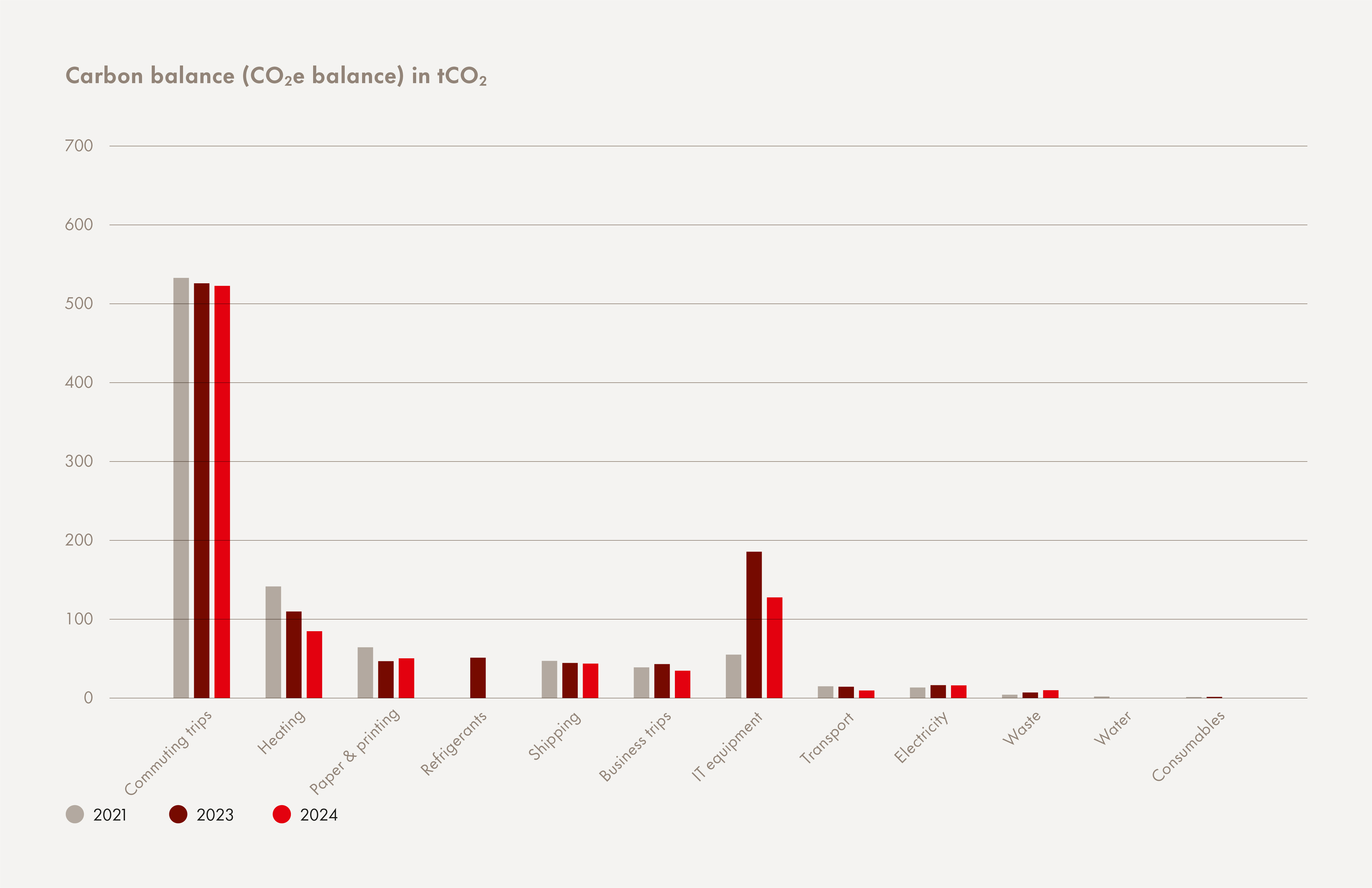
Direct and indirect operational greenhouse gas emissions (tCO₂e) | 2024¹ | 2023 | Change | Base year 2021 |
Scope 1: Direct GHG emissions | 51 | 123 | –58.5% | 98 |
Scope 2: Indirect GHG emissions | 16 | 16 | 0.0% | 16 |
Scope 3: Other indirect GHG emissions | 841 | 912 | –7.8% | 803 |
Total operational GHG emissions | 908 | 1'051 | –13.6% | 917 |
Operational GHG emissions in tCO₂e per employee | 1.6 | 1.9 | –15.8% | 1.8 |
1 Each year, SZKB can only report on the previous year’s emissions due to delays in the provision of data (internal and external dependence).
SZKB is committed to reducing greenhouse gas emissions and achieving the target of climate neutrality («net zero») by 2050 at the latest. It has set clear reduction targets that will be pursued as part of its transition plan. These targets are reviewed regularly (at least annually) using relevant metrics and key performance indicators (KPIs) to evaluate progress in meeting the targets. SZKB focuses on Switzerland’s climate strategy when setting its climate targets. However, achieving these targets requires not only a commitment by the financial industry and SZKB itself through the provision of education, advice and financing but also the creation of appropriate political framework conditions. In order to implement them successfully, it is crucial for Switzerland to pursue its net-zero target systematically and support the economy with the necessary incentives and regulatory measures.
Transition plan for financed emissions in the financing business
Achievement of objectives
As part of the transition plan to reduce financed emissions in the financing business, SZKB has set clear targets in order to play its part in achieving climate targets. Although initial measures have already been implemented, such as promoting a sustainable financing solution («handshake mortgage »), the emissions intensity in the portfolio has not yet been significantly reduced. This is due to factors that include structural, sector-specific conditions that require long-term adjustments. There has been no change in intensity for real estate, as emission factors are calculated using 2020 emission factors. SZKB only has actual consumption data in a few isolated cases. Due to the fact that renovations are constantly being carried out in the loan portfolio (third-party and self-financed), there will be further reductions in this area in the coming years.
Transition plan for financed emissions in the financing business
Financing | Targets | Methodology and data | Base year | Base value | 30/06/2025 | Measures |
Mortgages Residential buildings | 2030: Reduction of the emissions intensity of financed mortgages by 42% | Method: PCAF Scope 3, cat. 15 Scenario: Energy Perspectives 2050+; Zero basis scenario Metric: Intensity (kgCO₂ per m² financed area) (Scope 1+2) | 2022 | 24.2 kgCO₂/m² (Scope 1+2) | 24.2 kgCO₂/m² (Scope 1+2) | • Introduction of mandatory ESG training courses for all employees as well as training courses for sales employees and managers • Introduction of «handshake mortgage» as a mortgage for energy-efficient renovation • Raising awareness of mortgage clients concerning the energy efficiency of their property and supporting them in increasing the energy efficiency of their property • Integration of sustainability risks into risk management |
Mortgages Commercial property | 2030: Reduction of the emissions intensity of financed commercial property by 40% | Method: PCAF Scope 3, cat. 15 Scenario: Energy Perspectives 2050+, Zero basis scenario Metric: Intensity (kgCO₂ per m² financed area) (Scope 1+2) | 2022 | 23.3 kgCO₂/m² (Scope 1+2) | 23.2 kgCO₂/m² (Scope 1+2) | • Bank-wide ESG training for all employees and advanced training in sustainable finance or ESG in the financial sector for sales employees and managers • Introduction of the mortgage for energy-efficient renovation, including for commercial clients • Integration of sustainability risks into risk management |
Transition plan for financed emissions in the fund business and in asset management
Achievement of objectives As part of the transition plan for the investment and fund business, SZKB is pursuing compliance with the Paris Climate Agreement within the climate aspect of its ethical line, meaning that all investment instruments must follow the reduction path to net-zero CO₂ emissions by 2050 and implicitly ensure global warming of «only» less than 2.0 degrees according to the current state of scientific knowledge. 1 SZKB is on track to achieve the climate targets set using targeted measures, such as the expansion and strengthening of sustainable fund products. The progress made so far shows that the strategic focus is having an effect.
Transition plan for financed emissions in the fund business and in asset management
Fund business | Targets | Methodology and data | Base year | Base value | 31/12/2025 | Measures |
Funds with an «Aware» or «Focused» preference | The proportion of SZKB investment funds with alignment with client preferences of «Aware» or «Focused» as a total of all SZKB investment funds amounts to: 2025 at least 20% 2030 at least 50% | Method: SZKB profiling Metric: Share (volume size) in % Scenario: – | N/A | N/A | 40.6% | • Building of a systematic, independent investment controlling system as a second line of defence in planning • Integration of sustainability risks into risk management |
Ethical Fund | 2030 & 2050: adherence to the 2°C climate target in the Ethical Fund² | Provider: NGFS Model: REMIND – MAgPIE Metric: Implied temperature rise (target) | N/A | Compliance with the ITR per investment instrument <2.0°C | Compliance with the ITR per investment instrument <2.0°C | No specific measures |
Asset management | Targets | Methodology and data | Base year | Base value | 31/12/2025 | Measures |
AM mandates with an «Aware», «Focused» or «Effective» preference | The number of asset management mandates with client preferences «Aware», «Focused» or «Effective» out of the total of all asset management mandates amounts to: 2025 at least 20%. 2030 at least 50%. | Method: SZKB profiling Metric: Number of AM mandates in % Scenario: – | N/A | N/A | 36.7% | • Building of a systematic, independent investment controlling system as a second line of defence in planning • Integration of sustainability risks into risk management |
Core mandate Ethical | 2030 & 2050: Adherence to the below 2°C climate target for asset management mandates with a «Focused» preference² | Provider: NGFS Model: REMIND – MAgPIE Metric: Implied temperature rise (target) | N/A | Compliance with the ITR per investment instrument <2.0°C | Compliance with the ITR per investment instrument <2.0°C | No specific measures |
1 Absolute CO₂ emissions may also be higher than the benchmark over time. Furthermore, 10% of investment instruments do not have to fulfil this requirement (trash ratio). Applies to funds and, from 2027, also to AM. This is for practical reasons (in particular, reduction in the number of transactions and the related costs). 2 In previous years, the target was below 1.5°C.
Transition plan for direct and indirect operational greenhouse gas emissions (Scope 1 to 3)
SZKB has resolved to pay climate protection contributions for unavoidable operational CO₂ emissions starting for the first time in 2025, covering CO₂ emissions from the 2024 reporting year.
Achievement of objectives
SZKB’s operational CO₂ emissions fell by 143t from 1,051t in 2023 to 908t in 2024. This is mainly due to a reduction in emissions from the areas of procurement of IT equipment, business trips and oil/gas heating systems, but also, in particular, the lack of any refrigerant losses in 2024. Assuming that the reduction pathway for the 2027 target for operational CO₂ emissions (Scopes 1, 2 and 3) is linear, CO₂ emissions in 2024 would have had to be 853 tCO₂. At 908 tCO₂, the actual figure was 55 tCO₂ or 6% above the target under the reduction pathway.
Operations | Targets | Methodology and data | Base year | Base value | 2024¹ | Measures |
Operational CO₂ emissions (Scope 1, 2, 3) | 2027: Reduction of operational CO₂ emissions by 145.0 t to 770.0 tCO₂. 2030: 841.2 tCO₂ 2040: 650.9 tCO₂ 2050: 357.5 tCO₂ | Method: GHG Protocol/Swiss Climate: direct and indirect operational emissions (Scope 1, 2, 3) Metric: Absolute tCO₂ (Scope 1, 2, 3) Scenario: own calculations based on assumptions | 2021 | 917 tCO₂ | 908 tCO₂ | • Energy efficiency analysis at the headquarters in Schwyz and implementation of the resulting measures • Usage of photovoltaic installations and replacement of fossil heating systems |
KPI Scope 1: | 2030: 60.1 tCO₂ 2040: 30.1 tCO₂ 2050: 0 tCO₂ | See operational CO₂ emissions (Scope 1, 2, 3) | 2021 | 98 tCO₂ | 51 tCO₂ | See operational CO₂ emissions (Scope 1, 2, 3) |
KPI Scope 2: | 2030: 20.8 tCO₂ 2040: 10.4 tCO₂ 2050: 0 tCO₂ | See operational CO₂ emissions (Scope 1, 2, 3) | 2021 | 16 tCO₂ | 16 tCO₂ | See operational CO₂ emissions (Scope 1, 2, 3) |
KPI Scope 3: | 2030: 760.3 tCO₂ 2040: 610.4 tCO₂ 2050: 357.5 tCO₂ | See operational CO₂ emissions (Scope 1, 2, 3) | 2021 | 802 tCO₂ | 840 tCO₂ | See operational CO₂ emissions (Scope 1, 2, 3) |
Means of transport (Scope 3)² | 2030: Reduction of CO₂ emissions for means of transport (Scope 3) by 123.3 tCO₂ | Method: GHG Protocol/Swiss Climate: direct and indirect operational emissions (Scope 3) Metric: Absolute tCO₂ (means of transport Scope 3) Scenario: Energy Perspectives 2050+ | 2021 | 852 tCO₂ | 565 tCO₂ | Preparation of preliminary study for a mobility concept for reducing CO₂ emissions associated with means of transport |
1 Each year, SZKB can only report on the previous year’s emissions due to delays in the provision of data (internal and external dependence).
2 Means of transport Scope 3 comprises: commuter journeys, transportation, business trips, although without vehicles owned by the company.
Assessment of effectiveness
- SZKB reports climate-related financial risks in accordance with the TCFD recommendations.
- Switzerland’s climate strategy emphasises the importance of reducing CO₂ emissions in the building sector. To meet the targets outlined in the Swiss climate strategy, it is crucial to elevate the renovation rate for existing properties in particular. SZKB aims to reduce CO₂ emissions in the real estate sector by developing financing products (in addition to raising awareness among property owners) that foster and support sustainable behaviour on the part of mortgage borrowers.
- Data retention and improving data quality are still important, and SZKB will continue to make efforts on these fronts in the years to come.
- The development of a catalogue of ESG criteria for future integration into the financing process has been completed. This is intended to ensure that ESG aspects are taken into account within the process. In addition, exclusion criteria have been defined for certain sectors, the activity of which includes coal mining, oil and gas extraction or the mining of ores; these will be implemented gradually.
- The SZKB transition plan is periodically reviewed to assess progress and take into account new scientific findings and regulatory requirements.
SZKB considers the measures taken to be appropriate and effective.
Next steps
Switzerland’s climate strategy emphasises the importance of reducing CO₂ emissions in the building sector. To meet the resulting goals, it is necessary to elevate the renovation rate for existing properties in particular. SZKB sees actively contributing to the reduction of CO₂ emissions in the real estate sector as its mission.
Another focus is on maintaining and continuously improving data quality. This remains a key factor in order to achieve progress in climate reporting and control. Over the coming years, SZKB will work specifically on expanding underlying data and optimising data quality.
SZKB will review and further develop its sustainability strategy in 2026. As part of this process, existing topics, objectives and measures will be assessed for their effectiveness and continuing relevance, and will be adjusted if necessary.